Running a rental business means more than keeping your inventory in good shape. It’s essential to have the right documents in place to protect both you and your company should something go wrong. An equipment rental agreement is one of the most important documents you’ll use, and if you don’t have one yet, here’s our foolproof guide to building the right one for your rental business.
What is an equipment rental agreement?
An equipment rental agreement is a contract between your business and the person or company renting from you. It lays out what’s being rented, for how long, what it costs, and who’s responsible for what.
Take a construction rental company as an example. Say a contractor books a skid steer for a two-week job site. The equipment rental agreement would spell out the daily rate, the condition of the equipment before it leaves your lot, who covers fuel and basic maintenance, and what happens if the contractor needs it for an extra week.
Without that agreement in writing, you’re relying on a handshake, and handshakes don’t hold up when a $40,000 equipment comes back damaged.
Why does your rental business need one?
Every rental business runs into the same handful of problems eventually: damaged items, missing pieces, late returns, or a customer who insists they returned something in perfect condition when your photos say otherwise. An equipment rental contract gives you something to point to when that happens.
Picture an event rental company that just delivered a full setup of tables, chairs, a sound system, and lighting rigs for a Saturday wedding. The client keeps the gear an extra two days without asking. A speaker comes back with a torn cone. One folding chair never makes it back at all.
If your contract already spells out late fees, damage costs, and what happens with lost items, you’re not scrambling to figure out what’s fair on the fly. You already agreed on it, and the client already signed off on it.
This is also where a lot of businesses add an equipment rental waiver, a clause where the customer acknowledges the risks of using the equipment and agrees not to hold you liable for normal wear, minor malfunctions, or injuries that happen from improper use on their end. It won’t protect you from everything, but it closes a gap that a basic contract might miss.
How to structure your equipment rental agreement
A solid rental contract follows a pretty predictable order. Here’s what to include, section by section:
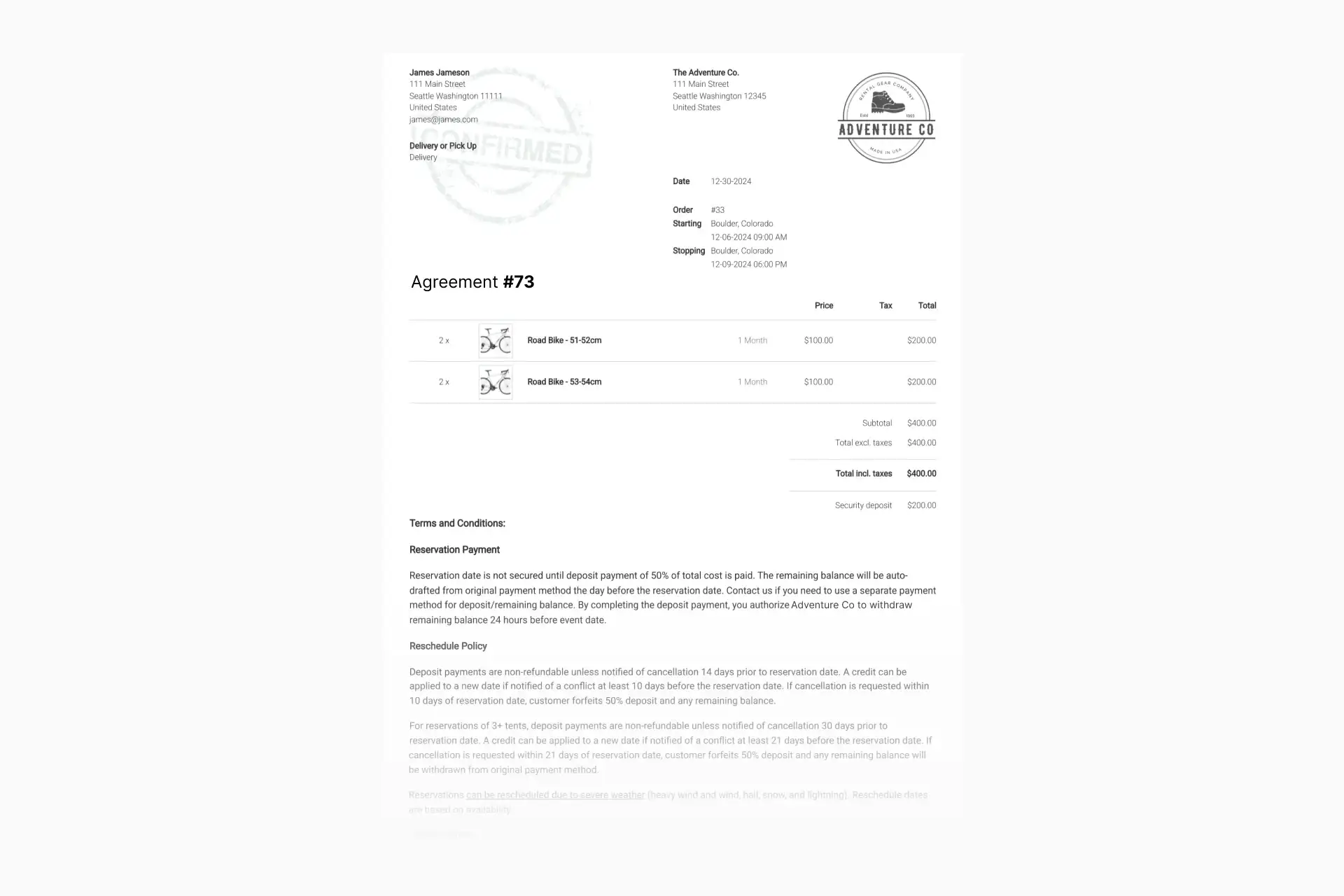
Customer details. Full legal name, address, phone number, and email. If it’s a business renting from you, get the company name and the name of the person signing on its behalf.
Your company details. Your legal business name, address, and contact information. This is basic, but skipping it is a surprisingly common mistake on DIY templates.
Dates. The date the contract is signed, and separately, the reservation period itself, meaning the exact start and end dates (and times, if relevant) of the rental.
Product lines with pricing. List every item being rented, with the rate per day or per rental period, then the price for each line based on how long it’s rented. Don’t bundle everything into one number. If a customer is renting five items for a week, they should be able to see the daily or weekly rate for each one.
Order summary. This goes near the bottom and totals everything up: subtotal before tax, any discounts applied, tax, and the final total. The security deposit amount should be listed here too, clearly separated from the rental cost itself, since deposits are usually refundable and taxed differently.
Terms and agreements. This is the legal backbone of the whole document, and it’s worth its own section (see below).
If you’re using rental software, most of this (customer information, product details, and order totals) gets filled in for you automatically. What you still need to think through carefully is the terms and agreements section, since that’s where your actual protection lives.
What to include in your rental terms and agreements
This section is where your contract earns its keep. It should cover:
-
Liability and damage. State clearly that the customer is responsible for the equipment while it’s in their possession, and what happens if it’s damaged, lost, or stolen.
-
Use restrictions. What the equipment can and can’t be used for, and any training or certification the renter needs before using it.
-
Cancellation and refund policy. What happens if the customer needs to cancel or change their reservation.
-
Insurance requirements. Whether the renter needs their own coverage, or whether you’re offering a damage waiver as an add-on.
Here’s where local law actually matters, and it’s worth walking through a real example.
Say you run a camera and AV rental business in California, renting out cinema cameras, lenses, and lighting kits to production crews. As California charges sales and use tax on most tangible personal property rentals, your terms should state clearly whether tax is included in the listed rate or added at checkout, since the California Department of Tax and Fee Administration treats rental receipts as taxable, including mandatory add-ons like damage waivers.
The laws that apply to your rental business completely depend on your country, state, city, and sometimes even your specific type of equipment. The best move is to consult a lawyer in your area to review your terms and agreements before you start using them with real customers. A generic template gets you most of the way there, but a quick legal review catches the stuff that’s specific to where you operate.
Your terms should also spell out payment terms clearly: including when payment is due, what forms of payment you accept, what happens if a payment fails or is late, and how deposits get refunded (and how long that takes). Vague payment terms are one of the most common sources of disputes, and they’re also one of the easiest to fix.
Why collecting a signature matters
None of the above means anything without a signature. In most cases, getting both parties to sign is what makes it much easier to enforce the agreement if a dispute arises. A signature is what turns your terms from a suggestion into something a customer has actually agreed to.
This matters even for repeat customers or people you know well. And it matters even more for higher value equipment, since a missing signature is one of the first things a customer’s lawyer will look for if a dispute ends up in a courtroom. Make signing part of your checkout process every single time, no exceptions.
Finding the best rental agreement template available
If you’re building contracts by hand, you’re spending time on something that should take a couple of clicks. Booqable makes creating and sending an equipment rental agreement part of the normal order flow instead of a separate task.
Here’s how it works:
-
Personalize your template. You can customize your contract template within your account once with your logo, terms and agreements, and the fields you want pulled in from each order.
-
Generate the contract. From any order placed within your account or received online, you can click to generate a contract and it will fill in automatically with the customer’s details, the rental dates, the products, and the pricing. No retyping, and no copy and paste.
-
Collect a signature. Customers can sign from the Booqable app on your phone or tablet if they’re standing in front of you, or they can sign on their own laptop or desktop while you’re together in person. Either way, it’s a digital signature captured right on the document. Once the document is open, you have two options:
-
Request signature: sends an email to the customer with a secure signing link, so they can sign remotely without you needing to be there.
-
Copy signing link: lets you send the link yourself, through text, WhatsApp, or whatever messaging app you and your customer already use.
-
-
Email it. Send the signed contract straight from the app or from your laptop, and the customer gets a copy for their own records.
Every contract you send is saved automatically within your account in the documents section with a link to the order it belongs to, so you’re never digging through email threads or a filing cabinet to find a signed copy. If a dispute comes up six months later, you can pull it up in seconds.
The power of getting it in writing
A good agreement is one of those things you don’t think about until you need it, and then you’re glad it’s there. Cover the basics: who’s involved, what’s being rented, the dates, the pricing, and clear terms and agreements that spell out liability, payment, and what happens if something goes wrong.
Get a signature every time, and have a lawyer in your area check your terms so they actually match the laws where you operate. And if you’d rather not build all of this from scratch, a tool like Booqable gets you a working equipment rental contract in a few clicks, ready to send and sign the same day.
This blog post is for informational purposes only and should not be considered legal advice. While we aim to provide accurate and up-to-date information about equipment rental agreements, laws and regulations can vary by jurisdiction and may change over time. You should consult with a qualified attorney or legal professional to ensure that your equipment rental agreement complies with applicable laws and addresses your specific business needs.